












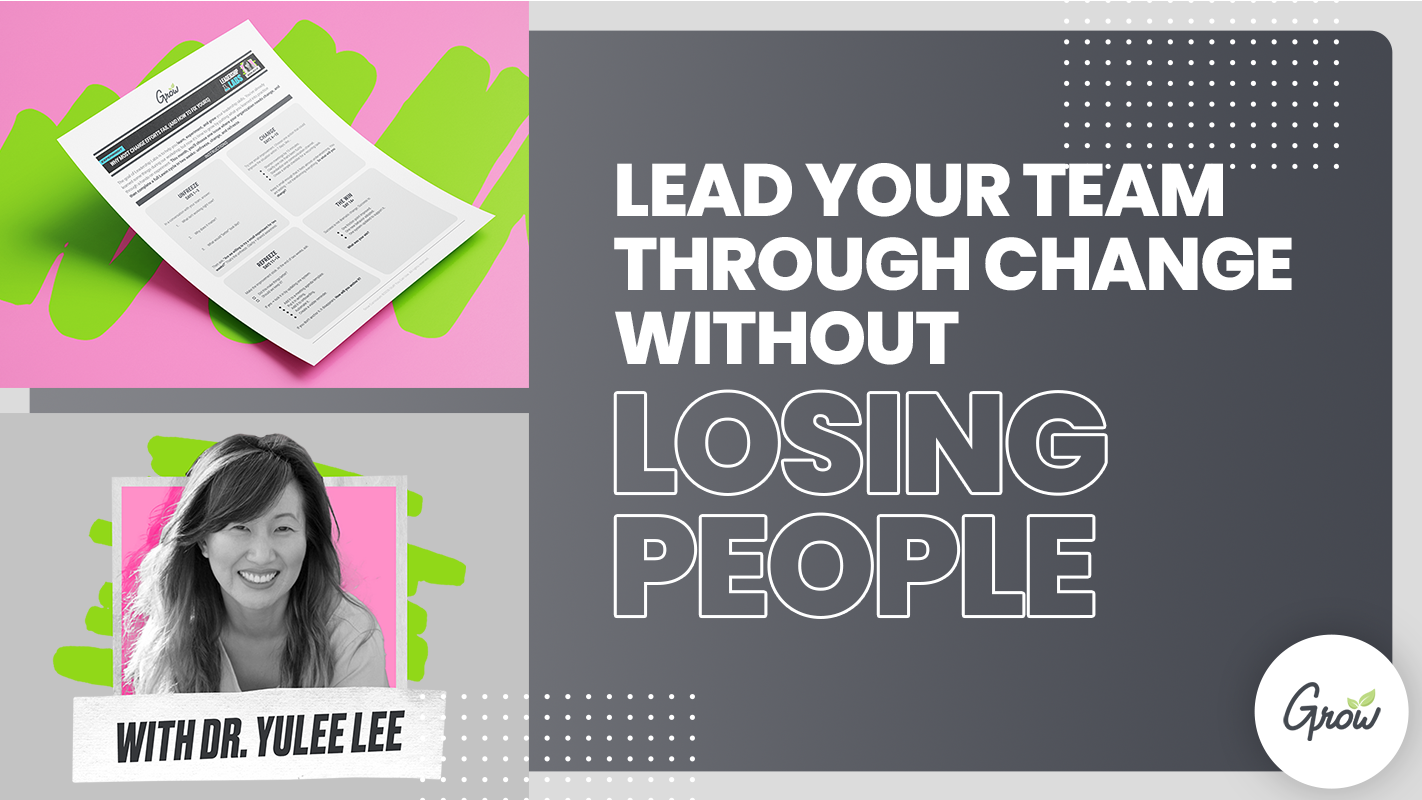
What’s the last change initiative you led that actually stuck?
- Not the one that just launched.
- Not the one you just announced.
- Not the one you barely survived.
- The one that stuck.
Here’s the uncomfortable truth – most change efforts fail. It’s often not because the idea can’t succeed, but because the process is flawed.
I’ll be hosting a live workshop on Zoom this month about this topic! If you want to join us to learn, discuss, and grow together, then sign up here for $9.97!
Harvard Business Review affirms this reality that nearly 70% of change initiatives fail. And the reasons are remarkably consistent:
- Leaders move too fast
- People don’t understand the purpose
- The past isn’t honored
- There’s no plan to stabilize the new normal
In other words, change fails when leaders treat it as a project rather than a transition.
Projects are operational.
Transitions are psychological.
And if you want change that lasts, you have to consider the psychology around it.
Leading Change Is About Transition
Kurt Lewin’s classic three-stage model remains one of the most durable frameworks in organizational change.
Unfreeze → Change → Refreeze
It’s simple.
It’s human-centered.
And it forces leaders to slow down when they most want to speed up.
Leading change is not about pushing things forward. Instead, it’s about guiding people through a transition.
Let’s walk through these three stages.
Stage 1 — Unfreeze: Help People Release the Old Way
This is the stage leaders skip most often because it feels slow.
But Lewin’s core insight is this – You cannot move people into a new future until you help them let go of the old one.
Letting go is emotional.
Research from William Bridges, who studied transitions extensively, shows that people don’t resist change — they resist loss.
We all fear the loss of…
- Competence
- Control
- Status
- Identity
- Familiar rhythms
When leaders rush past unfreezing, they interpret hesitation as resistance. But often what feels like hesitation is actually grief.
Unfreezing requires four things.
- Honor what worked in the past
- Clearly name why change is necessary
- Create psychological safety for questions
- Surface unspoken concerns
Stage 2 — Change: Introduce, Model, and Support the New Way
This is the stage leaders are most excited about. And, it’s also the stage where anxiety can spike for everyone else.
Lewin was clear – the leader’s role in this phase is to guide, not push.
Change succeeds when leaders can…
- Model the new behaviors first
- Provide clear, step-by-step directions
- Remove structural barriers
- Repeat the vision relentlessly
- Celebrate early wins
John Kotter’s research on transformation shows that change accelerates when teams experience early wins.
Small wins build belief.
Belief builds momentum.
People will struggle to commit to what they don’t see working.
Stage 3 — Refreeze: Stabilize the New Normal
This is the most unintentionally overlooked stage — and the reason so many initiatives quietly die, even if they get off to a good start.
Without refreezing, people revert to old habits because those habits are automatic.
Neuroscience research shows that habits are energy-efficient pathways. The brain defaults to what is familiar unless new behaviors are consistently reinforced.
Refreezing means:
- Clarifying new expectations
- Adjusting systems and processes
- Recognizing and rewarding new behaviors
- Aligning policies with the change
- Embedding language into culture
Lewin’s insight is this – change isn’t real until it becomes routine.
Organizational psychology research consistently shows that behavior becomes permanent when…
- Leaders consistently embody the change
- Systems reward the new behavior
- Old habits become harder than new ones
If the compensation plan, meeting rhythms, or performance metrics still reward the old way, people will drift back — every time.
Refreezing is alignment work.
Go Deeper in Leadership Labs!
Change doesn’t stick because you declare it. It sticks because you design a change process that keeps the psychology of change in mind.
👉 Sign up for our next Leadership Labs live workshop here! These workshops are designed to help you learn, experiment, and grow your leadership skills. With Leadership Labs, you’ll get…
- Live 60-minute Leadership Labs with me (Yulee!) and some special guests
- Live group discussion
- Note sheets for each session
- A practical leadership “experiment” to help you apply what you’ve learned in your ministry
And it’s only $9.97 for each workshop! Sound like something you could use? Then sign up here and let’s grow our leadership skills together!
Yulee Lee, PhD
Chief Operating Officer
✉️ [email protected]
🌐 growcurriculum.org
🌐 stuffyoucanuse.org








In this post, here’s what we’ll cover: